What This Post Is About
- Why posture patterns matter and how they impact your confidence
- The correct riding position that works across all disciplines
- Three common posture mistakes riders make (and how they affect you)
- Two simple exercises you can start today to improve your balance and posture
- How posture and confidence are directly connected
- Resources to help you strengthen your position off the horse
Your posture isn’t just about looking good in the saddle - it’s the foundation of your effectiveness - and your confidence.
The way you sit, balance, and carry yourself directly influences how secure you feel and how clearly you communicate with your horse.
With correct posture, you’ll feel:
- More balanced and secure in the saddle
- Able to move with your horse’s rhythm instead of against it
- Clearer and more effective in your aids
- More confident every time you ride
With poor posture, you’re more likely to:
- Feel tense and unsteady
- Grip and brace (which makes you less secure, not more)
- Send confusing signals to your horse
- Lose confidence in your riding
Watch this short video below to see simple posture adjustments.
Note: If you find yourself "freezing" or gripping despite knowing the correct position, your nervous system is likely in survival mode. You can learn to reset that response in my Stop Riding Scared Mini-Course.
Why Posture Patterns Matter
We all fall into habitual patterns in how we hold our bodies.
Those patterns feel “normal” even when they create problems - like straining your joints, creating tension in your horse, and feeling insecure in the saddle.
The challenge?
Familiar feels comfortable. Even when it’s not helping you.
Changing your posture can feel awkward at first. But with practice you’ll build new muscle memory that makes correct posture feel normal.
And the result? A seat that feels balanced, grounded, and confident.
The Correct Riding Position
This is the posture that gives you balance, security, and confidence in any discipline:
- Vertical line from ear → shoulder → hip → ankle
- Pelvis tilted so seat bones point straight down
- Lower back flat (not arched)
- Even weight on both seat bones and down both legs
- Feet rest in stirrups - avoid pushing down
- Chest lifted and open without stiffness
- Head balanced, chin parallel to the ground
- Knees drop long, thighs relaxed, calves gently hugging
- Heels lower than toes naturally (no forcing)
- Elbows bent softly, straight line from bit to elbow
When you're in this riding posture, you instantly feel more secure and more confident.
3 Common Posture Errors That Undermine Confidence

Riding Position - Perching

Riding Position - Correct Alignment

Riding Position - Behind The Vertical
1. Perching
Weight tips forward onto the pubic bone. Your inner thigh grips, lower leg slides back. You feel unstable and less in control.
2. Arched Lower Back
Pelvis tips forward, bottom sticks out, belly protrudes. Looks “aligned” but your lower leg is unsteady. Creates stiffness and tension.
3. Behind the Vertical
Shoulders drop behind the hips, weight tips to the back of the seat. You stiffen your arms and neck. Your legs slide into a “chair seat,” and use your reins to balance.
All three positions create imbalance and tension - chipping away at your confidence because you feel insecure in the saddle.
2 Simple Exercises to Improve Your Riding Posture
Do these exercises on a safe, quiet horse in a safe location or on the lunge line with an experienced horse person.
Start out practicing the movements at the halt and then progress to the walk.
It’s helpful to have a practice with a ground person or another rider so you can take turns observing and giving feedback.
Exercise 1: Finding Centre
This exercise will help you recognize the “feel” of being centred or having the correct vertical alignment.
- You’ll move between 3 positions – centre, forward and back.
- Engage your core muscles to give you stability.
- In each position, notice what happens in your body. Where are you gripping and tensing?
Centre – This exercise can be done with your feet in or out of the stirrups.
Sitting squarely over both seat bones, let your legs drop out of the hip sockets and have an observer tell you when your shoulders are over your hips.
Notice what that feels like.
Forward – Slowly, without moving or gripping with your legs, move your chest slightly (1 – 3”) towards your horse’s neck by closing your hip angle.
Without moving or gripping with your legs, return to centre.
Back – Slowly, without moving or gripping with your legs, lean back slightly (1 – 3”) towards your horse’s tail by opening your hip angle.
Without moving or gripping with your legs, return to centre.
Exercise 2: Half-Seat Balance
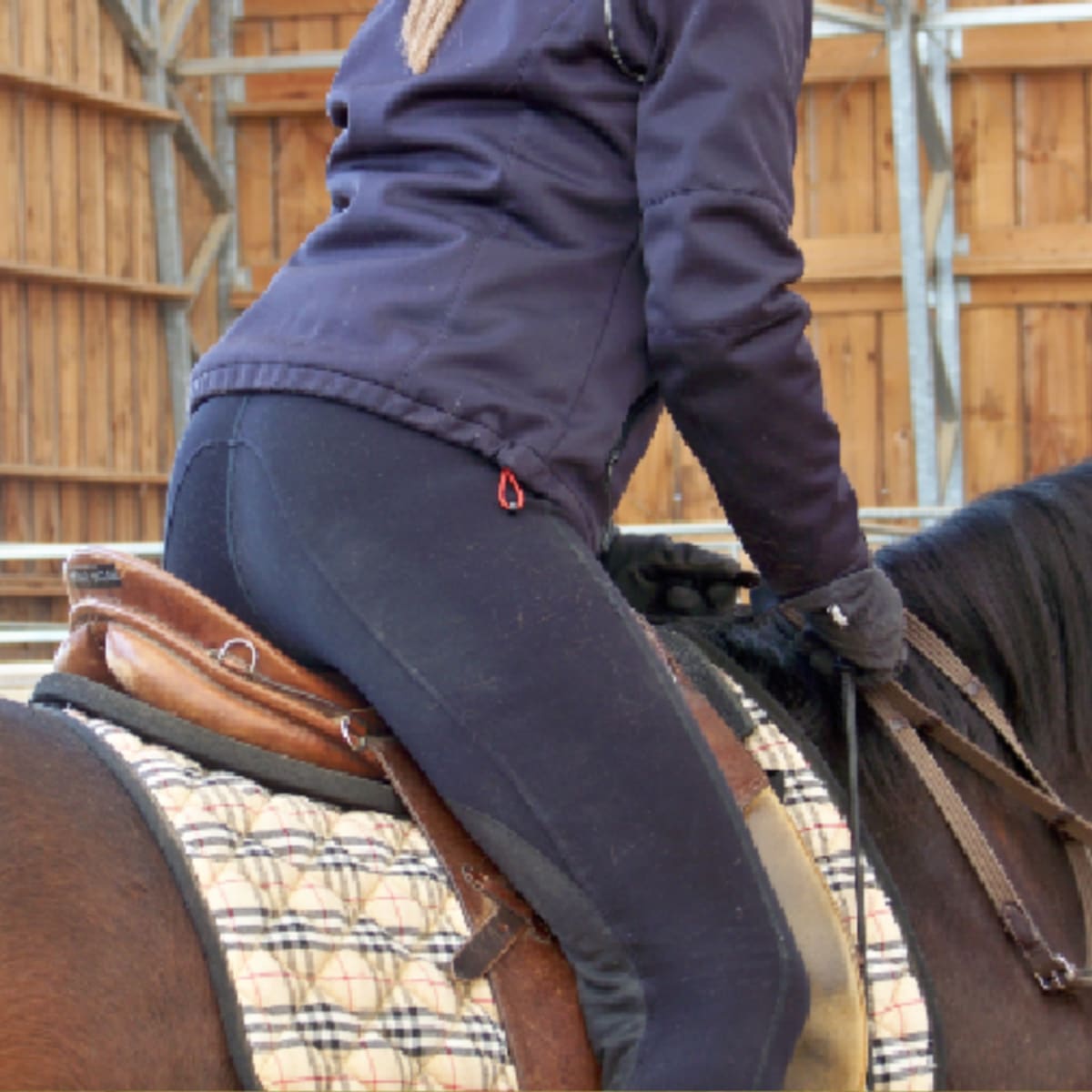

Supporting yourself with your knuckles on your horse’s neck (keep your wrists straight and fingers closed), engage your core as you close your hip angle and slightly lift your seat bones up and back.
Make sure your lower back is flat.
Breath deeply and release any tension from your shoulders, arms, neck, and back.
Soften your ankles, knees, and hips. Focus on balancing your hips over your ankles.
Once you feel balanced, lift your hands off your horse’s neck (you can do one hand at a time) and see if you can maintain this posture.
Increase the challenge of this exercise by doing it at the trot.
Why Practice Doesn't Always Make Perfect
Even with the best exercises, if your brain feels "scared," it will override your posture and force you to unconsciously grip for safety.
Before you can truly fix your position, you have to calm the "what-if" thoughts. My Stop Riding Scared Mini-Course is the perfect starting point to help you release that deep-seated tension so these posture exercises actually work.
Looking for the biomechanical side? You can also access my masterclass: 5 Quick Fixes to Improve Your Riding Posture.
 If you’d like even more practical ways to improve your posture, check out my pre-recorded masterclass: 5 Quick Fixes to Improve Your Riding Posture
It’s packed with simple, off-horse exercises you can do anytime to feel stronger, more balanced, and more confident in the saddle.
The Confidence - Riding Posture Connection
When your posture is correct, you:
- Feel secure and capable
- Communicate clearly with your horse
- Release tension from your body and mind
- Ride with confidence
Small changes in your riding posture can create big changes in how confident you feel - and how well your horse responds.
Take the Next Step Toward Confident Riding
Posture is the physical foundation, but mindset is the mental one. I offer three ways to help you build both:
The Quick Start: Get the Stop Riding Scared Mini-Course. This 7-module programme gives you the grounded, physiological tools to stop riding nerves so your body can remain soft and balanced.
The Posture Deep-Dive: If you feel mentally calm but physically "stuck," my recorded masterclass 5 Quick Fixes to Improve Your Riding Posture focuses on the off-horse exercises you need to stay secure.
The Personalised Path: For riders ready for 1-on-1 mindset coaching and hypnosis, book a free Confidence Call. We’ll discuss your specific challenges and how to get you enjoying every ride again.
Related Resources
FAQs
Correct posture makes you feel secure and balanced. Poor posture creates tension, imbalance, and self-doubt.
A vertical ear–shoulder–hip–ankle line, even seat bone weight, flat lower back, heels under hips, and soft, bent elbows with a straight line from bit to elbow.
Perching forward, arching the lower back, and leaning behind the vertical. Each of these creates imbalance and reduces confidence.
Practice exercises like “Finding Centre” and the “Half-Seat Balance.” For a deeper dive, try my masterclass 5 Quick Fixes to Improve Your Riding Posture for exercises you can do off-horse to improve your posture in the saddle.
